


AI & Tech Weekly (Sept 8–12): Oracle’s $455B Contracts, Apple’s iPhone 17 & Air, Tesla Robotaxi, Anthropic’s Soaring Valuation, and More
The past week once again highlighted the fast-moving landscape of AI and technology. From Oracle’s massive contract reserves to Apple’s product launches, Tesla’s Robotaxi milestone, and Anthropic’s skyrocketing valuation, global tech giants are pushing boundaries at an unprecedented pace. Here are this week’s top eight stories with analysis.
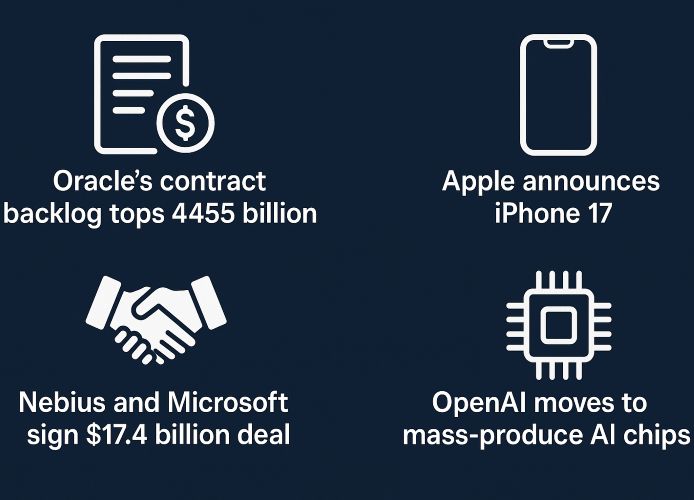
1. Oracle’s Contract Reserves Surpass $455B, Covering OpenAI, xAI, and Meta
Oracle revealed its contract reserves have reached $455 billion, with $317 billion added in just the first quarter. Major AI players such as OpenAI, xAI, and Meta are among its clients. Chairman and CTO Larry Ellison emphasized that the AI inference market will “far exceed” training and outlined the company’s strategy to dominate inference with its “AI Database.”
Analysis:
A $455 billion contract reserve is explosive news. Most of these are multi-year cloud service agreements, ensuring tens of billions in stable revenue. Oracle is rapidly evolving from a database specialist into an AI-era star. Its Autonomous Database, deeply integrated with generative AI, enables vector search, low-latency queries, and real-time data processing—earning the label of a “game-changing product.”
2. Apple Launches iPhone 17 Series and iPhone Air Alongside Multiple New Devices
Apple unveiled the iPhone 17 lineup, the ultra-thin iPhone Air, Apple Watch Series 11/SE3/Ultra 3, and AirPods Pro 3. At just 5.6 mm, the iPhone Air is the thinnest iPhone ever, powered by the A19 Pro chip, Apple’s self-developed N1 Bluetooth chip, and the C1X modem, with support for “all-day battery life.”
Analysis:
The highlight of this launch is the full integration of Apple Intelligence. iOS 26 brings real-time translation and personalized interactions, significantly enhancing the user experience. Meanwhile, Apple Watch and AirPods Pro 3 leverage AI algorithms for advanced health monitoring, including intelligent blood pressure and heart rate analysis. The iPhone Air’s combination of extreme thinness with the A19 Pro chip stole the spotlight.
3. Nebius Signs $17.4B GPU Contract with Microsoft, Stock Soars 49%
Nebius secured a $17.4 billion contract with Microsoft to supply GPU infrastructure for its New Jersey data center. The five-year deal could expand to $19.4 billion with additional services. Following the news, Nebius’ stock price surged over 49% the next day.
Analysis:
The $17.4 billion agreement—potentially up to $19.4 billion—translates to $3.5–3.9 billion in annual revenue. This represents a significant boost to Nebius’ financials and cements its growing position in the GPU infrastructure market.
4. Tesla’s Shanghai Gigafactory Orders Surge, Robotaxi Approved for U.S. Road Tests
In August 2025, Tesla’s Shanghai Gigafactory delivered 83,000 vehicles. The newly launched Model Y L (six-seater SUV starting at RMB 339,000) received 35,000 orders on its first day and surpassed 120,000 by early September. The Model 3 Long Range also achieved a record 830 km range. Meanwhile, Tesla received approval to test Robotaxi services on public roads in Nevada, USA.
Analysis:
Shanghai’s Gigafactory once again demonstrated Tesla’s strong production capacity and rapid market response. The Model Y L, targeting Chinese families’ need for space, proved a hit with soaring orders. The Model 3’s 830 km range highlights Tesla’s edge in the premium EV segment. Most importantly, Robotaxi road-test approval marks a crucial milestone toward autonomous driving commercialization. Tesla’s Full Self-Driving is no longer just driver assistance—it’s moving toward fully autonomous deployment. Increasingly, investors are recognizing Tesla as an AI and robotics company, not merely an automaker.
5. Anthropic’s Valuation Triples in Six Months to $183B
Anthropic’s valuation skyrocketed from $61.5B to $183B within six months. Amazon has invested $8B in total, tying Anthropic closely to AWS’s Trainium and Inferentia chips, while Google has invested over $3B. Third-party data shows Anthropic’s revenue reached $3B in May 2025.
Analysis:
The surge reflects investor confidence in the commercialization potential of the Claude models. AWS not only supports Anthropic’s compute needs but also distributes Claude via Amazon Bedrock to enterprise customers. Projections suggest AWS revenue from Anthropic could reach $1.28B in 2025, $3B in 2026, and $5.6B in 2027. This trajectory positions Anthropic as one of the fastest-growing SaaS players while boosting AWS’s AI dominance.
6. OpenAI Partners with Broadcom to Mass-Produce Custom AI Chips
OpenAI is partnering with Broadcom to mass-produce its custom-designed AI chips, expected to roll out next year.
Analysis:
With NVIDIA holding roughly 80% of the AI chip market—and GPUs expensive and supply-constrained—OpenAI’s chip initiative aims to cut costs and secure stable compute resources. Broadcom’s expertise in AI ASICs makes it a crucial partner, strengthening OpenAI’s push to reduce dependency on NVIDIA and secure vertical control over its compute stack.
7. Baidu Releases Wenxin X1.1 Model, Fully Open to Enterprises and Developers
Baidu launched the Wenxin X1.1 deep reasoning model, highlighting improvements in factuality, instruction-following, and agent capabilities. It is available via Baidu’s website, app, and the Qianfan Cloud platform for enterprises and developers.
Analysis:
The release reinforces Baidu’s leadership in China’s AI model market. With advanced reasoning and multimodal capabilities comparable to DeepSeek R1/V3, and seamless integration across Baidu’s ecosystem (search, maps, etc.), enterprises and developers can deploy advanced AI without starting from scratch—dramatically cutting time and costs.
8. Alibaba Launches “Gaode Street Ranking,” Challenging Meituan’s Local Services Dominance
Alibaba introduced the “Gaode Street Ranking,” similar to review-based platforms but built on actual navigation behaviors (searches, routes, arrivals, favorites) and Alipay Sesame credit scores.
Analysis:
This “behavior + credit” model reduces fake reviews and enhances trustworthiness. With Gaode’s 1B+ users and 120M daily local searches, Alibaba has a natural advantage. Combined with aggressive plays like Taobao Flash Sales and Ele.me subsidies, Meituan’s long-held lead in local services may face real challenges.
Over the past week, AI and technology developments underscored their immense momentum and capital appeal. From Oracle’s long-term cloud strategy to Tesla’s autonomous driving breakthrough, and from Anthropic’s valuation boom to Alibaba’s challenge in local services, AI is increasingly shaping the global tech landscape.
For more frontier AI insights, business analysis, and tech trends, stay tuned: iaiseek.com