


Dec 20, 2025 · 24-Hour AI Briefing: Musk’s $56B package revived, SoftBank’s $22.5B OpenAI bet, and ChatGPT turns groceries into a “task” funnel
The last 24 hours underscored three recurring themes in AI: governance boundaries, capital positioning, and distribution power. A court decision re-drew the line on performance-based mega-compensation; a mega-fund is reshaping its balance sheet to buy an AI-era seat at the table; ChatGPT continues to evolve from answers to actions in high-frequency commerce; and platform pushback against large-scale scraping signals a harder line on content redistribution.
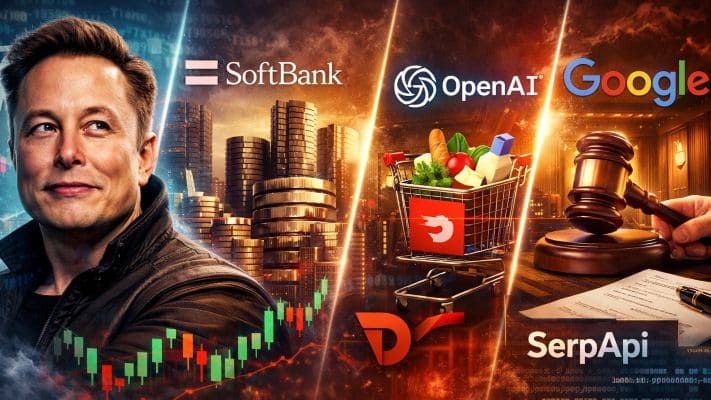
1. Delaware Supreme Court restores Musk’s 2018 Tesla pay package worth $56B
The Delaware Supreme Court reversed a lower-court rejection and restored Elon Musk’s 2018 performance-based Tesla compensation plan, which allows discounted stock purchases tied to aggressive milestones.
Commentary:
In 2024, the lower court voided the plan citing “procedural unfairness.” The Supreme Court’s reversal effectively expands the legal runway for ultra-high-stakes, milestone-driven executive incentives. But the market’s core questions remain: when incentives become large enough to influence ownership structure and control, are board independence, disclosure, and procedural integrity truly robust?
Musk did oversee Tesla’s rise from roughly a $50B market cap to over $1T and reportedly met all 12 demanding targets—delivering outsized shareholder returns.
Still, this ruling is bigger than one executive. It is a concrete re-clarification of corporate governance norms, shareholder power, and the boundary of judicial intervention.
2. SoftBank sells assets to fund a $22.5B OpenAI capital commitment by year-end
SoftBank is raising funds via asset sales and balance-sheet moves, aiming to complete a $22.5B investment commitment to OpenAI by the end of the year.
Commentary:
SoftBank is not just “investing in AI”—it is buying strategic optionality. The playbook reads like balance-sheet reshuffling: exiting NVIDIA (about $5.83B), trimming T-Mobile (about $9.17B), pledging Arm shares to expand credit lines, plus layoffs and a PayPay IPO plan.
This looks less like a pure financial bet and more like a bid for an industrial chokepoint: models, distribution, compute, and application ecosystems. Becoming a core OpenAI capital partner could give SoftBank a stronger “synergy narrative” across its portfolio.
For OpenAI-class companies, the next few years’ biggest variables may be less about raw capability and more about compute cost, supply chain, and commercialization efficiency. SoftBank selling “steady” assets to fund “fever” assets is a classic hedge against missing the next platform shift.
Does this time, the gamble pay?
3. DoorDash + OpenAI launch ChatGPT grocery flow: recipes to cart, then app checkout
DoorDash and OpenAI rolled out a grocery-shopping capability: users ask ChatGPT for recipe ideas, generate a shopping list, and then jump to the DoorDash app to complete checkout.
Commentary:
Recipe inspiration is among ChatGPT’s most common consumer use cases. For DoorDash, this is high-intent demand capture: users initiating a recipe query are often close to purchase, potentially converting far better than conventional ads—without paying the same customer acquisition tax.
For OpenAI, it is another proof point for “task AI monetization”: not only answering, but moving users into transaction funnels in a high-frequency category.
The downside is equally clear. If OpenAI integrates additional competing partners, DoorDash’s advantage can dilute. And forced app switching at checkout adds friction that may reduce completion rates.
4. Google sues SerpApi over scraping: the “mass fake requests + commercial redistribution” line
Google filed suit against SerpApi, alleging the firm generated hundreds of millions of fake Google search requests to unlawfully obtain copyrighted content at scale and redistribute it commercially.
Commentary:
This is not merely a scraping dispute. It is a fight over scale, intent, and monetization—turning a platform’s “finished product” into free raw material for resale.
SerpApi positions itself as a developer tool that structures search results into an API for SEO and market intelligence. Google’s framing is that this directly undermines its core business model and control over the content ecosystem.
How the court draws the boundary between “tooling,” “fair use,” and “industrial-scale extraction” may materially shape data services, scraping markets, and AI-era redistribution norms.
For broader context, here are the most important AI events from the past 72 hours: