


Dec 30, 2025 · 24-Hour AI Briefing: Meta Buys an Agent Shortcut, Jensen Tests Succession, TSMC 2nm Marks the GAA Era
Over the past 24 hours, three signals stand out: Big Tech is using “acquisition + distribution” to seize the AI agent entry point; the GPU king is placing long-horizon bets on robotics and simulation; and process leadership is shifting from pure scaling to device-structure and system-level co-optimization.
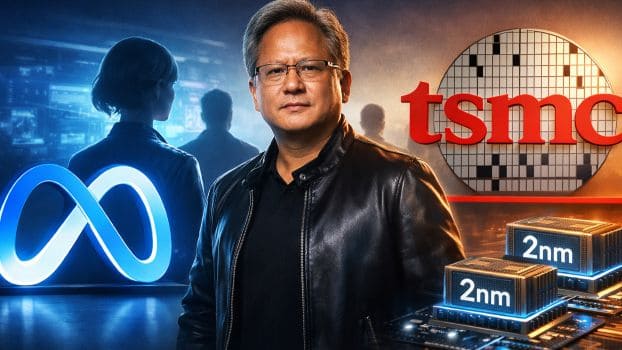
1. Meta acquires AI application developer Manus for several billions, marking its third-largest deal ever.
Commentary:
Meta has Llama, massive user data, and unmatched social distribution—but it has lacked a truly breakout AI agent product. Manus, positioned as a general-purpose agent, can independently run market research, code, analyze data, and plan travel—closing the loop from “think → plan → execute → verify.” For Meta, this isn’t about owning another model. It’s about binding Llama and Meta’s distribution directly to something sellable—bridging the missing middle layer between open-source capability and revenue.
More broadly, this is a milestone in the industry’s shift from “model arms race” to “agent productization.” The winners will be those who can package intelligence into repeatable, billable workflows—not just impressive demos.
The risk: Meta’s recent AI acquisitions look like puzzle pieces rather than a single dominant entry point. Buying Manus can accelerate productization, but it won’t automatically “flip the narrative” unless Meta deeply embeds Manus-like loops into WhatsApp/Instagram/Facebook in a way that creates durable retention and monetization.
2. Jensen Huang’s two children enter NVIDIA’s core leadership, sparking succession debate.
Commentary:
Jensen Huang’s daughter, Madison Huang, and son, Spencer Huang, have moved into core leadership roles—leading Omniverse (simulation software) and robotics product lines. Notably, neither is placed in NVIDIA’s most profitable datacenter/GPU core. Instead, they’re assigned to robotics and Omniverse—still investment-heavy, but framed by Jensen as the “second half” battleground of AI.
In Silicon Valley, this challenges traditional elite governance norms. Strategically, it’s surprisingly coherent:
-
It keeps succession sensitivity away from the cash cow.
-
It tests leadership in long-cycle businesses where outcomes are measured over years, not quarters.
-
It signals internally that robotics and simulation are central—not side bets.
If NVIDIA is an “AI infrastructure company,” Omniverse and robotics are arguably the most stable future demand engines: simulation as the industrial substrate for training/deployment, and robotics as AI’s biggest expansion from screens into the physical world.
If you were Jensen, would you structure succession this way—and why?
3. TSMC confirms 2nm mass production in Q4 2025, signaling a GAA-led new era.
Commentary:
TSMC’s 2nm is its first mass-production node using nanosheet GAA transistors—moving the industry from FinFET into GAA as a mainstream reality. The significance is not just “smaller geometry,” but a new primary battlefield:
-
Gate control and channel engineering dominate outcomes.
-
Device/interconnect/power-delivery co-design becomes critical.
-
DTCO and yield ramp determine real commercial advantage.
For AI, bottlenecks are increasingly system-level: HBM, interconnects, packaging, power delivery, and cooling often matter more than node branding. 2nm helps push performance-per-watt higher and eases datacenter power/TCO pressure—but it won’t decide the war alone. Shipment and margin will still be driven by advanced packaging capacity/yield, HBM supply coordination, and whether customers can translate node gains into system and software-stack benefits.
So who truly rivals TSMC? The closest peer will be the one that can win the full “process + packaging + ecosystem” systems battle—not merely chase the most aggressive node headline.
To quickly recap the most important threads from the past 72 hours, read: