


December 13, 2025 · 24-Hour AI Briefing: Robinhood’s AI Finance Bet, Xiaomi’s Robotics Push, Memory Pricing Shockwaves, and Intel’s Acquisition Gamble
Over the past 24 hours, AI’s influence continued to spill into finance, robotics, enterprise hardware pricing, and semiconductor M&A. These developments may look disconnected at first glance, but together they point to a deeper shift: AI is increasingly reshaping system-level capabilities, not just standalone features.
From Robinhood’s attempt to redefine retail finance, to Xiaomi’s focus on robotic manipulation, and from AI-driven memory shortages to Intel’s search for relevance through acquisition, the industry is entering a more structural phase of competition.
Below are today’s four most important AI developments, with context and analysis.
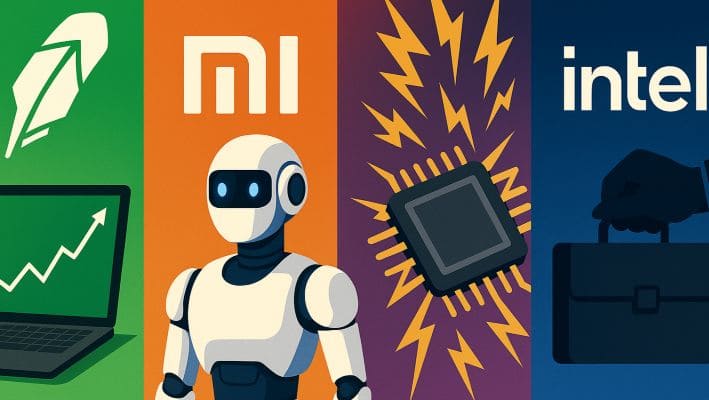
1. Robinhood to unveil AI innovations and prediction market features
Robinhood plans to reveal new AI-driven products and prediction market functionality at a December 16 event led by CEO and Chairman Vlad Tenev.
Commentary:
Robinhood appears to be positioning itself for a transition—from a zero-commission brokerage into an AI-native financial operating system. Prediction markets are fundamentally event-driven trading engines, and for a retail-focused platform, they are naturally more viral and engagement-friendly than traditional equities.
However, AI’s real challenge in finance is not intelligence, but whether risk controls can be embedded into the product experience itself. The moment AI-generated signals start to resemble directional buy/sell guidance—or funnel users toward high-risk event trading—Robinhood risks triggering regulatory and public scrutiny around “induced trading” and suitability obligations.
This upcoming launch could expand Robinhood’s narrative—or introduce an entirely new category of risk.
2. Former Tesla Optimus dexterous hand engineer joins Xiaomi
Lu Zeyu, previously part of Tesla’s Optimus dexterous hand team, has joined Xiaomi to lead development of robotic dexterous hands.
Commentary:
In humanoid robotics, locomotion is largely solved. Manipulation is now the real dividing line between demos and utility. Dexterous hands mark the transition from robots that can move to robots that can work.
Xiaomi’s decision to spin dexterous hands into a dedicated initiative—with a clear technical owner—signals ambitions beyond showcase prototypes. Engineers coming out of Tesla’s Optimus program typically bring two key capabilities: hardware systems engineering, and end-to-end control with data feedback loops.
If Xiaomi can turn dexterous hands into a reusable platform component, combined with its manufacturing scale and quality control, the outcome may extend beyond internal use—potentially forming a broader robotics component ecosystem.
The open question is whether this path can truly scale to real-world deployment.
3. Memory and storage shortages push Dell to raise prices across commercial products
Due to tightening DRAM and NAND supply, Dell has announced price increases across its entire commercial product lineup.
Commentary:
Memory capacity is being aggressively absorbed by AI infrastructure. Google, Meta, Microsoft, and NVIDIA are purchasing massive volumes of HBM and high-capacity DDR5 for large-scale model training. Meanwhile, manufacturers such as Samsung, SK Hynix, and Micron are reallocating advanced-node capacity toward higher-margin AI products.
The result is shrinking supply for consumer-grade DRAM and NAND used in PCs and smartphones. Dell’s decision—coming from a top-three global PC vendor—signals that upstream shortages have reached industry-level pricing power.
Short term, this is a hardware price increase. Long term, it represents a restructuring of enterprise IT cost models, driven by AI infrastructure economics. Whether Lenovo and HP follow next will be a key signal.
4. Intel reportedly in talks to acquire SambaNova Systems
Reports suggest Intel is in advanced discussions to acquire AI chip startup SambaNova Systems for approximately $1.6 billion, though neither side has confirmed the talks.
Commentary:
If accurate, this move reflects Intel’s recognition that its internal AI roadmap has been too slow, its ecosystem too weak, and its mindshare too fragile. Acquisition becomes a shortcut to filling gaps in accelerators and software stacks.
Intel has pushed aggressively into AI with Gaudi training chips and inference-focused GPUs, yet it still lacks a mature, end-to-end AI software platform. That is precisely where SambaNova’s value lies—its RDU architecture, integrated full-stack solution, and commercial deployment experience.
Even if the acquisition closes, the real test remains execution. Whether Intel can turn SambaNova into a genuine reversal story—or merely a patch—will define its role in the next AI cycle.
Past 72 Hours: Key AI Developments Worth Revisiting
For broader context, readers may also revisit the following recent briefings:
Conclusion
Today’s AI stories reinforce a growing reality: the next phase of AI competition is structural, not superficial.
Winning will depend less on model size or flashy demos, and more on how effectively companies integrate risk control, manufacturability, cost discipline, and ecosystem leverage into their systems.
This is no longer a race to build smarter AI—it is a race to build AI that can actually scale.