


Feb 13, 2026 · 24-Hour AI Briefing: MiniMax Pushes Agents to “$1/Hour,” Alphabet Funds an AI Supply War with Century Bonds, Rivian Turns Gross Profit Positive via Software
In the last 24 hours, three signals converged: pricing is rewriting what’s viable for agents, capex is becoming a competitive weapon, and EV makers are increasingly judged by recurring software economics—not just unit deliveries.
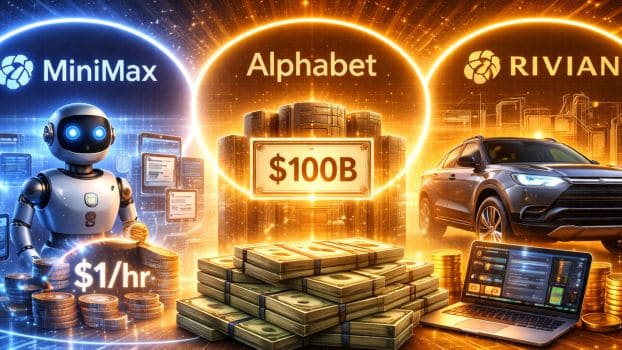
1) MiniMax releases M2.5: priced at just 1/10 to 1/20 of Claude Opus, Gemini 3 Pro, and GPT-5-class models
Commentary:
MiniMax’s M2.5 effectively compresses complex agent runtime costs to the “$1/hour” tier, turning long-running, high-frequency, multi-turn agents from a luxury into a default tool. For cost-sensitive SMBs and indie developers, that’s the real unlock: near-top-tier usefulness at a fraction of API spend, plus free daily quotas and private deployment options that lower adoption friction.
Once cost stops being the bottleneck, competition shifts from “who’s cheaper” to “who completes complex tasks reliably and efficiently.” MiniMax’s move is clear: pull real enterprise usage via extreme price/perf rather than short-term leaderboard hype. At 1/10–1/20 the price, many teams will redesign their inference budget—and their product architecture.
Will SMBs actually pay for M2.5 at scale?
2) Alphabet’s $100B century bond is 10x oversubscribed, aimed at funding AI capex
Commentary:
A $100B bond with a 100-year tenor is a statement: finance AI infrastructure like a generational build-out, pushing near-term P&L pressure outward to secure long-lived compute and datacenter supply advantages. The 10x oversubscription suggests markets buy the narrative that Alphabet can convert capex into durable cash flows.
In a supply-constrained AI world, capex becomes a weapon. Whoever can reliably turn power, racks, networking, and GPUs into deliverable compute gets leverage in cloud inference, enterprise subscriptions, and advertising intelligence. This financing move signals Alphabet wants the fight at the “resources and delivery” layer—not only model quality.
But there’s a real asymmetry: tech evolution can be exponential and non-linear, while debt service is linear and rigid. If the next decade brings an AGI paradigm shift, a quantum breakthrough, or a decentralized AI wave, today’s heavy capex bets could depreciate faster than expected.
3) Rivian posts $1.29B quarterly revenue; software & services at $447M (+109% YoY); $120M gross profit; FY2025 gross profit turns positive at $144M
Commentary:
Even with FY2025 deliveries down ~18%, Rivian achieved positive full-year gross profit for the first time. That’s a meaningful structural milestone, typically driven by lower per-unit costs, improved pricing/mix, and stronger non-vehicle contribution.
Software and services growth is the headline because it shifts the story from one-time hardware margins to repeatable revenue. But fast growth doesn’t guarantee quality: long-term value depends on segment margins, retention, and how much of “services” is truly recurring. And at ~42K annual deliveries, Rivian still hasn’t reached the scale where manufacturing economics become self-reinforcing—future profitability remains tightly coupled to cost-down curves and ramp execution.
Are you bullish on Rivian in 2026?