


Feb 18, 2026 · 24-Hour AI Briefing: Meta Locks NVIDIA’s Full-Stack, Google I/O Teases Gemini + Smart Glasses, Tesla Brings Grok In-Car Across Europe
In the last 24 hours, three themes sharpened at once: the AI race is being redefined by long-term supply lockups and full-stack delivery; “AI agents” are moving from apps into OS-level and wearable form factors; and vehicles are being repositioned as always-on, real-world AI endpoints.
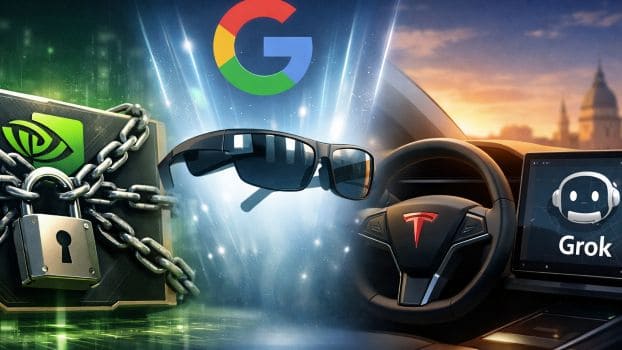
1. Meta signs a multi-year deal with NVIDIA: millions of chips for AI datacenters, including NVIDIA’s latest standalone CPU
Commentary:
Meta is reportedly the first major enterprise to deploy NVIDIA’s Grace CPU independently in its datacenters—breaking the long-standing “x86 CPU + NVIDIA GPU” default and shifting toward an end-to-end NVIDIA stack: Grace-Hopper superchips plus Spectrum-X networking. This isn’t just capacity expansion; it’s a systems architecture decision that consolidates compute, networking, and software into one tightly coupled supply chain for predictable performance and delivery.
The bigger signal is the phrasing: “multi-year” + “millions.” That’s supply-chain binding. Meta is trying to lock several generations of deliverable compute, pushing competition from “whose model is better” toward “who can consistently secure and deploy capacity.” In a supply-constrained AI cloud/training market, certainty often matters more than peak specs.
NVIDIA’s role continues to evolve from GPU vendor to platform vendor: CPU + GPU + networking + software sold as a unified AI factory. Meta isn’t just buying accelerators—it’s buying a more complete infrastructure blueprint, while NVIDIA secures multi-billion-dollar demand and further strengthens its share in the AI chip market.
Instead of spreading effort across internal CPU bets or second-tier suppliers, Meta is effectively concentrating its wager on the most mature full-stack option available right now. Do you agree with that “maximum focus, maximum lock-in” strategy?
2. Alphabet confirms Google I/O for May 19–20: expected Gemini updates and a potential smart glasses launch
Commentary:
The real test at this I/O probably isn’t “Gemini got smarter,” but whether Google can turn AI back into an end-to-end product system: model capability → developer stack → device distribution. Google has been pushing Gemini beyond a chatbot into a cross-device, multimodal, real-time “general AI agent.”
If you’re watching for substance, look at three things: whether long-context reasoning becomes more controllable and reliable; whether “Deep Think” style modes meaningfully raise task completion on hard problems; and whether native tool use is stable enough for real agent workflows. If Gemini is deeply integrated into Android 16 as a system service—so users can complete tasks via voice/vision without opening an app—that’s Google’s distribution moat fully activated.
Smart glasses are the higher-variance bet. Google Glass still casts a shadow, and “always-on camera” privacy concerns must be addressed aggressively through permissions, indicators, on-device processing, data retention rules, and transparent controls. If Google can make glasses feel natural, useful, and non-intrusive, it could kick off a genuine “ambient intelligence” cycle.
If I/O focuses on Gemini upgrades + smart glasses, are you actually excited for what Google ships this year?
3. Tesla begins rolling out xAI’s Grok in Model 3 and Model Y: voice control, navigation, and Q&A across nine European markets (incl. the UK)
Commentary:
The headline isn’t “cars now have a chatbot.” It’s Tesla moving AI from entertainment-style conversation into an operational in-car interface. If voice control, navigation, and in-cabin Q&A work reliably, Grok becomes a persistent interaction layer—not a feature checkbox. For Tesla, it pushes the car further toward a continuously updated software platform; for xAI, it’s a rare distribution channel with high-frequency real-world voice interactions and feedback loops.
Europe-first is also strategic. The rollout is positioned with privacy and compliance in mind: Grok chats default to end-to-end encryption, and xAI claims it won’t link interactions to a Tesla account unless the user explicitly logs in—an attempt to reduce friction under EU scrutiny. Multi-language support (English, German, French, etc.) and Europe-specific navigation behavior also make the region a natural stress test.
In a world of tightening AI regulation in the US and China, Europe can function as a “neutral proving ground” to accumulate safety and operations data before scaling globally.
Tesla adding Grok looks like a voice assistant upgrade on the surface, but it’s really an attempt to redefine the car as a “wheeled AI agent.” If you were buying a Tesla, would Grok-style in-car voice assistance be a feature you’d actually use long-term?
Most important AI events from the last 72 hours:
If 2024–2025 was about model capability races, 2026 is increasingly about delivery and supply chains: who can lock compute, who can turn AI into a system-level distribution layer, and who can place agents into high-frequency real-world contexts will have the most durable advantage.