


H200 Production Ramp Rumors, BYD Overtakes Tesla: Jan 2, 2026 · 24-Hour AI Briefing
In the last 24 hours, the biggest swing factor for AI compute is still the tug-of-war between demand and compliance: China’s model build-out keeps accelerating, while export/import approvals remain uncertain. In parallel, the EV battlefield offers a blunt lesson for the AI supply chain: scale, cost, and execution are what turn technical advantage into durable wins.
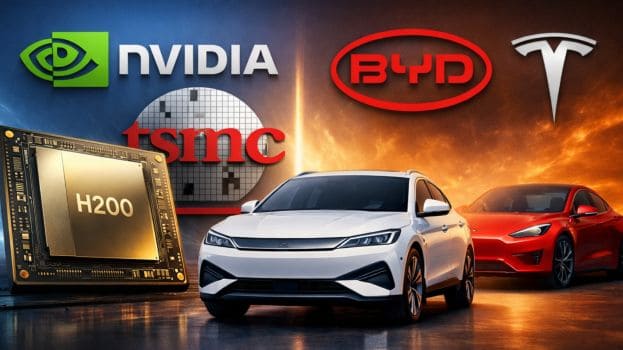
1. Rumor: NVIDIA asks TSMC to ramp H200 production as China demand surges.
Analysis:
Market chatter claims China internet giants (e.g., Alibaba, ByteDance) have collectively ordered more than 2 million H200 GPUs. At an estimated ~$27,000 per unit, that implies a headline figure of roughly $54B. The same rumor thread suggests NVIDIA’s current inventory is only around 700,000 units, leaving a large gap; the remaining ~1.3 million units would depend on TSMC’s production expansion and deliveries in the second half of 2026. These numbers remain unverified and should be treated cautiously.
Product-wise, H200 is widely viewed as materially stronger than the China-allowed, downgraded H20—often cited as up to ~6× higher performance, with ~40%–50% higher memory bandwidth—making it especially suitable for LLM training and inference. If supply and compliance both clear, demand could concentrate rapidly.
Policy is the real gating item. The rumor notes a U.S. export-control adjustment on Dec 8, 2025, allowing H200 sales to China, but China-side regulators have not yet approved H200 imports. That means “allowed to sell” does not automatically translate to “able to ship,” creating substantial uncertainty for delivery and revenue timing.
Net: China’s model race is still running hot and GPU appetite is real, but H200 outcomes hinge on three constraints at once—manufacturing ramp, export compliance, and import approval.
2. BYD surpasses Tesla in 2025 sales, becoming the world’s largest EV maker.
Analysis:
If the figures hold (BYD BEV ~2.25M vs Tesla ~1.64M), the message is not simply “who builds better cars.” It’s that the EV endgame is increasingly defined by scale and supply-chain efficiency.
BYD’s first-time lead in global BEV volume signals a deeper structural shift. Tesla remains heavily concentrated in Model 3/Model Y, with a narrower lineup and weaker coverage in the mass-market price band (roughly RMB 100k–200k), where volume is won or lost. BYD’s vertically integrated stack (battery, motor, power electronics, semiconductors) enables tighter cost control and stronger competitiveness in that segment.
That said, volume alone is not destiny. In China, intensified competition from brands like Geely, Xiaomi, Leapmotor, and Li Auto pressures margins and pushes BYD to lean harder on overseas growth. The strategy looks solid so far, but profitability, policy/trade risks, and global channel execution will determine whether “#1 by volume” becomes a sustainable position.
The Most Important AI Stories in the Last 72 Hours
Closing note: In early 2026, the compute narrative will be driven less by raw benchmarks and more by whether supply and regulatory pathways can clear simultaneously. EVs are a reminder that, in hard tech, winners are often decided by scale economics and execution discipline.