


Jan 13, 2026 · 24-Hour AI Briefing: Gemini Becomes Apple’s AI Backbone, NVIDIA + Eli Lilly Build an AI Drug-Discovery Line, and AWS Bets on Hollow-Core Fiber
Today’s signals land across three layers of the AI stack: the consumer “front door” (Siri/Apple Intelligence), the platformization of life sciences (AI drug discovery), and the next-gen data-center network substrate (HCF). The pattern is clear: AI competition is expanding from model quality into ecosystem binding, industrial workflows, and infrastructure upgrades.
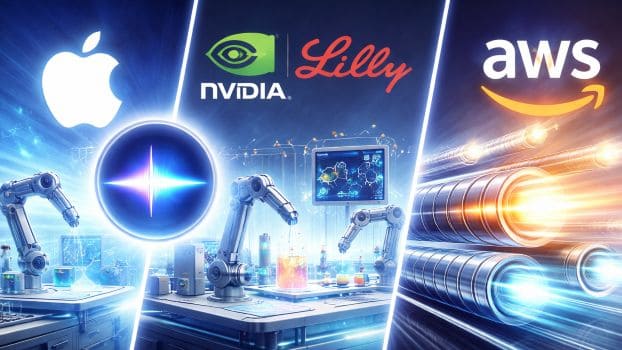
1. Google confirms a multi-year deal with Apple: Gemini supports Apple Foundation Models and the next-gen Siri; Musk warns of “unreasonable concentration of power”
Commentary:
If Gemini becomes a core foundation for Apple’s next-gen models, it’s not just a supplier swap—it’s a shift in what Siri can be. The implication is a move from a long-criticized “command executor” toward a contextual, multimodal, cross-app “personal agent” inside Apple Intelligence.
The deal also highlights a practical reality: Apple’s in-house AI progress hasn’t matched the market’s urgency for a smarter assistant. Partnering with a top external model is the fastest path to close the experience gap.
Privacy and control are the sensitive core. As described, this partnership is limited to foundational training/enhancement while user interaction data remains under Apple’s control; Gemini does not directly access device-side user data.
Still, the competitive concern is understandable: Google already dominates key gateways (Android, Chrome, Search). Deep model-level embedding into Apple’s ecosystem could mean a massive iOS installed base running a Siri experience grounded in Gemini. That kind of cross-ecosystem binding can weaken competitive pressure—exactly the angle behind Musk’s criticism.
For users, it’s a familiar trade: better Siri now versus worries about concentration and privacy. Which do you prioritize?
2. NVIDIA and Eli Lilly form a JV to invest $1B over five years in an AI-driven drug-discovery lab
Commentary:
This is a meaningful step toward industrializing AI drug discovery—from “buy compute, run experiments” to an integrated line that combines compute, data, and automated wet-lab loops. The value is less about a single model and more about binding the iteration workflow into a repeatable production system.
But expectations need calibration: clinical trials and regulatory approval remain the long poles. AI can improve hit rates, trial design, and patient stratification, but “months-level” end-to-end compression is unlikely. Better KPIs are: discovery throughput, attrition rate, cost per candidate, and time from hit to IND.
Strategically, NVIDIA continues shifting from GPU vendor to life-sciences platform builder (models + DGX Cloud + workflows). Lilly strengthens its position by scaling an AI-native pipeline. Do you think this partnership can deliver measurable, repeatable efficiency gains?
3. AWS deploys hollow-core fiber (HCF) to connect 10 data centers; may replace traditional fiber, but cost and supply are constraints
Commentary:
Optical networking is inching from “glass era” toward an “air era.” For AWS, deploying HCF is not only validation—it’s a strategic bet on the next network substrate for AI clusters.
Why HCF? Light propagates faster in air than in glass. For campus-scale synchronization, storage replication, and distributed training, even microsecond-level improvements can translate into meaningful throughput and tail-latency gains at scale.
HCF also keeps most of the optical path in an air core, potentially helping with certain non-linearities and dispersion as the industry pushes toward 800G/1.6T links. AWS has a track record of differentiating at the infrastructure layer (NICs, switches, DPUs, optics ecosystem). If HCF works, it becomes a long-term card for its AI networking stack.
But the hard constraints are real: cost, scalable supply, and operational reproducibility will decide whether HCF graduates from limited deployments to standard practice.
Closing:
From Gemini in Apple’s foundation layer to an AI drug-discovery production line to HCF-based networking, AI is becoming a systems race. Which layer builds the strongest moat first in 2025: the consumer front door, industrial platforms, or data-center network substrates?
Further reading (top AI events in the last 72 hours):