


Jan 21, 2026 · 24-Hour AI Briefing: China’s Open-Source Surge Goes Global, OpenAI’s Ad Pivot Tests Trust, Intel Lands a Massive SHIELD Ceiling Deal
Three headlines—open-source adoption, monetization pressure, and defense supply chains—are actually the same story: AI is entering an era where institutions and infrastructure decide outcomes. Distribution and interfaces shape ecosystems, business models shape trust, and national security logic shapes demand certainty.
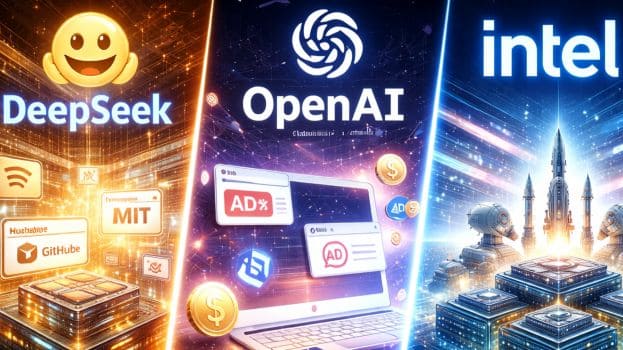
1. Hugging Face: After DeepSeek R-1, downloads of China-built models exceed any other country
Commentary:
China’s LLM ecosystem has entered a high-intensity, scaled open-source investment phase—and that effort is translating into visible adoption on global developer channels like Hugging Face. DeepSeek R-1’s MIT license plus low-cost inference puts “usability” above “parameter size,” pressuring incumbents to reposition.
More importantly, this is not just “voluntary alliance.” Under compute constraints and cost pressure, open source becomes a form of forced alignment: GitHub/Hugging Face turns into “global off-balance-sheet R&D,” expanding iteration beyond company walls. Under constraints, the ecosystem can iterate faster than closed “islands.”
If developers globally get used to Qwen-style APIs and DeepSeek-style interfaces, how do other regions respond? The open question is whether hype converts into durable enterprise reliability, engineering stability, and long-run product economics.
2. OpenAI accelerates monetization: ads arrive in ChatGPT for some US users, while ex-Meta hires increase
Commentary:
An organization once defined by “mission-first” narrative is moving into a hard, likely irreversible monetization phase—partly forced by cost realities, partly chosen to compete in the AI arms race.
But ads inside an AI assistant are uniquely risky: users will naturally wonder whether answers are commercially biased. ChatGPT’s value proposition is reducing noise and improving decisions; mishandled ads can pull it back toward “feed logic,” while raising privacy, child safety, and regulatory compliance concerns.
Trust may be the core asset. If users suspect outputs are shaped by incentives, product value degrades quickly. Even if OpenAI says ads won’t affect answers and chat data won’t be sold to advertisers, would you accept ads inside ChatGPT if there’s no better path?
3. Intel wins a US SHIELD program chip supply contract with a ceiling of $151B
Commentary:
After decades of offshoring, the US defense stack is trying to eliminate dependency risk: SHIELD’s core demand is that critical defense chips be produced domestically by US companies in secure, isolated environments.
The US government has also taken an equity position in Intel (reported 9.9% after a major injection), making this feel like an “internal loop” of state capital + state demand: investor and customer converge.
Still, a $151B ceiling is not guaranteed spend. Intel’s real win condition is sustained task orders and consistent delivery—yield, compliance, and lifecycle support. But directionally, it’s a meaningful positive signal.
Closing:
China’s open-source push is turning into measurable global adoption, OpenAI is testing how far monetization can go without eroding trust, and Intel is benefiting from defense-driven reshoring logic. AI competition is no longer just model quality—it’s APIs, ecosystems, business incentives, and supply-chain institutions. Which factor do you think reshapes the market first: open-source interface standardization, trust erosion from ads, or policy-backed domestic manufacturing demand?
Further reading (top AI events in the last 72 hours):