


Jan 24, 2026 · 24-Hour AI Briefing: Google Backs Sakana AI to Win Japan, Meta’s Smart Glasses Face an IP Shock, and Amazon’s Layoffs Reveal the “AI Efficiency” Playbook
Today’s stories span investment, litigation, and workforce restructuring—but they converge on one point: AI competition is no longer just model performance. It’s localization moats, IP landmines, and organizational cost curves.
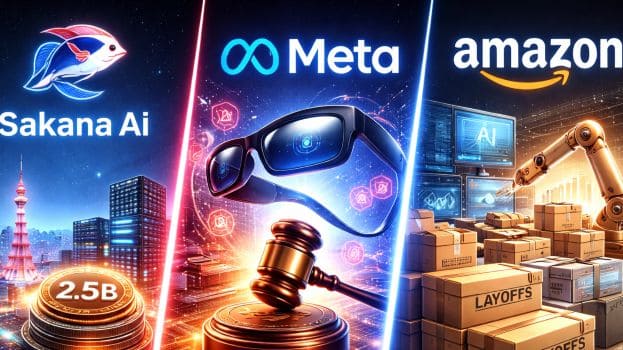
1) Google invests in Japan’s Sakana AI at a $2.5B valuation
Commentary:
Sakana AI’s edge is its founding team’s deep academic + engineering DNA. For Google, this is not just financial—it’s strategic: reinforcing Gemini’s localization and penetration in Japan and building a domestic partnership moat in a key APAC market.
As model capability converges, the real differentiators become unit cost, latency, and scalable deployment. If Sakana’s approach delivers measurable training or inference efficiency gains, even single-digit improvements can compound into massive advantages at Google-scale usage.
Do you think this bet pays off?
2) Meta and EssilorLuxottica are sued over alleged Solos Technology smart-glasses patent infringement
Commentary:
Smart glasses are moving from pilots to scale, which makes IP risk exponentially more dangerous. Any injunction, import restriction (via an ITC path), or “you can’t use key components/features” ruling can freeze manufacturing and channel rollouts—especially as shipments approach the tens-of-millions range.
Solos isn’t a random startup. It was founded by Dr. Kenneth Fan, a National Academy of Engineering member and a pioneer in micro-displays and wireless communications. Solos has worked on athlete-focused smart glasses since 2015, with deep investment in multimodal sensing, low-noise audio processing, and lightweight human–computer interaction.
For Meta, avoiding IP landmines while scaling fast is a defining test of whether it can lead the next mainstream computing platform. How do you think Meta responds?
3) Amazon plans thousands of layoffs across AWS, Prime Video, Retail, and HR
Commentary:
Officially, this is framed as fixing cultural issues created by aggressive hiring. But the underlying driver is obvious: AI tooling is making “fewer people, higher output” operationally viable. While AWS leadership downplays AI as the direct cause, Amazon reportedly has 1,000+ internal AI applications, with ~70% of HR recruiting workflows handled by AI agents, and AWS engineering productivity up ~35% with AI tools.
With AWS growth lagging Azure and Google Cloud, margin discipline matters—and low-price ecommerce pressure (Temu/Shein) forces cost optimization across the org. Savings are increasingly recycled into AI infrastructure spend.
The real question isn’t headcount. It’s whether layoffs come with real flattening, clearer ownership, and sharper project focus. Will AWS keep cutting as AI accelerates?
Closing:
Google is building localization leverage in Japan, Meta is confronting IP risk as smart glasses scale, and Amazon is rewriting its cost curve around AI efficiency. In the next year, which is the biggest “giant-killer” risk for Big Tech: localization, IP litigation, or org execution?
Further reading (top AI events in the last 72 hours):