


Jan 8, 2026 · 24-Hour AI Briefing: AWS Goes “Dual-Track” with P6E + Trainium3, Alibaba Cloud Targets Multimodal Hardware, Arm Nears a Datacenter Inflection Point
Three stories today reveal how the stack is shifting: AWS is pairing top-end NVIDIA rack-scale systems with its own silicon to control both peak capability and long-term cost; Alibaba Cloud is trying to standardize multimodal interaction into a hardware-ready toolkit; and Arm’s datacenter rise—while metric-dependent—is reshaping the CPU narrative inside hyperscale clouds.
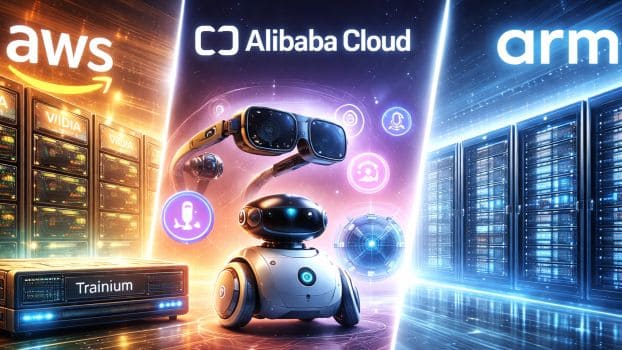
1. Amazon launches EC2 P6E instances based on GB NVL72 systems, and introduces Trainium3 UltraServer
Commentary:
AWS is building an end-to-end loop from chips and servers to clusters, platforms, and agent applications. The strategy is explicit: use the most capable NVIDIA rack-scale systems to absorb the hardest frontier training/inference, while using in-house Trainium to secure long-term cost and supply control.
Whether custom silicon can truly carry enterprise workloads comes down to three things: software stack maturity and migration friction, end-to-end cluster capability, and verifiable price/performance that holds up outside slide decks.
AWS is clearly spending to keep both options open—peak performance now, cost control over time. The question is whether customers will follow AWS onto that dual-track path.
2. Alibaba Cloud releases a multimodal interaction development kit for AI glasses, learning devices, and other hardware
Commentary:
The kit integrates multiple foundation models (including Qwen and related multimodal stacks) and ships with a set of prebuilt agents/tools aimed at daily-life and productivity scenarios. The goal is to package “listen, see, think, and interact with the physical world” as reusable engineering building blocks for device makers.
Unlike single-modality hardware, this push emphasizes deep fusion across voice, text, images, and video, backed by an optimized device-cloud collaboration architecture. Reported latency targets are aggressive—sub-1s end-to-end voice interaction, ~1.5s video interaction, and even ~1.3s / 98% accuracy in some customized scenarios.
This is a bet that multimodal devices will scale. If Alibaba can productize routing, device-cloud coordination, cost, and compliance, it could become a default base layer for hardware vendors—otherwise it risks staying at the “demo layer.”
3. Claims that Arm has reached 50% share in datacenter CPUs spark debate, but the directional shift is clear
Commentary:
Whether Arm has truly reached 50% in datacenter CPU share is disputed, but its growth and structural breakthrough inside hyperscalers are hard to ignore. Amazon and Microsoft adopting Arm-based custom silicon is driven by TCO, energy efficiency, customization, and supply-chain control—areas where Arm’s licensing model and ecosystem fit well. NVIDIA’s Arm-based CPU push also helps move Arm from “internal cloud optimization” toward a more general datacenter platform narrative.
That said, Arm still faces the entrenched x86 ecosystem in traditional enterprise datacenters and general-purpose servers.
And the biggest issue is measurement: 50% by units, cores, cloud instance share, or new procurement mix? Change the denominator and you change the headline.
Closing:
From AWS’s dual-track compute strategy, to Alibaba’s attempt to standardize multimodal hardware interaction, to Arm’s datacenter momentum—today’s pattern is “platform control” more than raw benchmarks. What do you think becomes the real wedge in 2025: chips, platforms, or the next hardware entry point?
Further reading (top AI events in the last 72 hours):