


Mar 2, 2026 · 24-Hour AI Briefing: Android’s System-Level Agents, NVIDIA’s Inference “Specials,” and Robotaxi Unit Economics in Shenzhen
In the past 24 hours, three stories mapped neatly onto three layers of real-world AI deployment: phones moving from “assistants” to system-level agents that can execute tasks; datacenters shifting from training bragging rights to inference efficiency and delivery form factors; and autonomous mobility inching forward via hard operating metrics. The common thread is clear: AI is becoming a systems business.
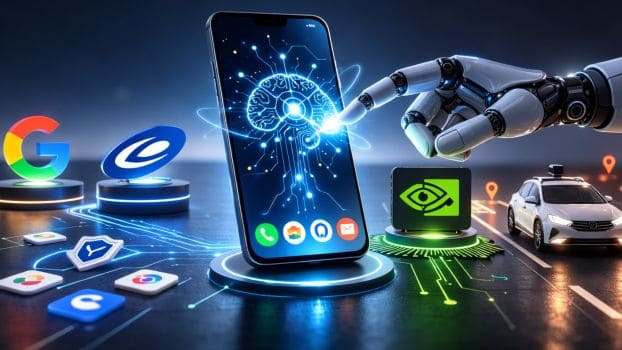
1. Google and Samsung plan to ship integrated AI Agent features on Galaxy S26 and Pixel 10, aiming for a “Doubao-phone-like” experience
Commentary:
China’s popular “Doubao phones” leaned heavily on high-privilege GUI agents—screen recording plus simulated taps to automate across apps. It’s powerful, but it bypasses app APIs, can trigger risk controls, and carries higher privacy exposure, which at times led to restrictions from major apps.
Google and Samsung appear to be pursuing a more sustainable path: encourage developers to expose structured action APIs (with early support from services like Uber and DoorDash), enabling safer and more efficient execution. For apps that aren’t integrated, the fallback is constrained visual automation running inside a sandbox to reduce overreach.
The hardest problem isn’t whether an agent can act—it’s whether it can act safely. Once an agent can send messages, place orders, or change calendars, the cost of mistakes becomes real. Users care less about “smart” and more about “don’t touch my stuff without control.” That means stronger defaults: permission tiers, confirmation for high-risk actions, reversibility, end-to-end audit logs, and local-first handling for sensitive data. Would you pay extra for that kind of phone experience?
2. NVIDIA plans a new processor tailored for customers like OpenAI, aligning with the shift from training to inference
Commentary:
Training is increasingly crowded; inference is becoming the profit pool. OpenAI has reportedly explored alternatives (including specialized chip startups) and even internal chip efforts. For NVIDIA, losing a flagship customer would be more than revenue—it would be a narrative and ecosystem shock.
A customer-specific inference processor would signal a clear pivot: competition is moving from “bigger training clusters” to “cheaper, higher-throughput, more reliable inference factories.” That likely means form factors optimized for throughput and latency distribution (P99), memory/KV-cache behavior, low-precision paths, and tighter software–hardware co-design rather than peak FLOPs.
This also looks like a tighter binding strategy: keep hyperscalers and top AI labs inside the full stack (chips + systems + software + operations) to preserve pricing power. The open question is whether major buyers—already pursuing multi-vendor strategies and internal silicon—will find this kind of “custom lock-in” compelling.
3. Pony.ai says its 7th-gen Robotaxi fleet reached unit-economics breakeven in Shenzhen on Feb 28: RMB 338 net revenue per car per day, 23 daily orders per car
Commentary:
Shenzhen is a uniquely favorable testbed—one of the earliest cities with legal frameworks for L4 driverless commercial operations, with complex roads but high user acceptance. If the numbers hold, the signal isn’t “the company is profitable,” but that the vehicle-level operating model can at least cover direct costs.
Unit-economics breakeven usually excludes major fixed costs like R&D, simulation, mapping, compliance, and expansion. It’s a necessary condition, not a sufficient one.
The real cost killer in Robotaxi isn’t electricity—it’s people and operations: remote assistance, incident handling, customer support, roadside response, and vehicle cleaning/maintenance SLAs. The key questions are durability and portability: can that order volume and net revenue persist over time, and can it be replicated in other cities with different demand density and policy conditions? Scale is where many fleets see unit economics worsen before they improve.