


The Short Answer
DeepSeek V4 Preview does three things meaningfully better than its predecessors: long-context processing (up to 1M tokens), cost-efficient inference via MoE architecture, and improved agent-task performance. It does not replace closed-source frontier models across the board. If your workflow involves large codebases, multi-document research, or API-scale deployments, V4 is worth paying attention to. If you're a casual user, the upgrade is mostly invisible.
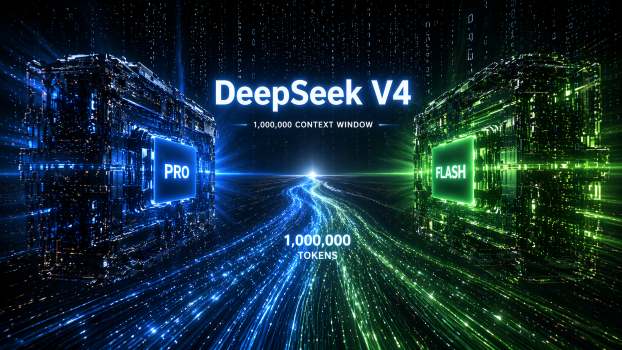
What V4 Actually Changed
DeepSeek V4 Preview is not an incremental update. Three things shifted structurally:
Architecture: MoE (Mixture of Experts) means only a fraction of parameters activate per request — 49B for Pro, 13B for Flash — which is why both models run faster and cheaper than their parameter counts suggest.
Context window: 1M tokens is now the ceiling. That's not the default; it's the upper bound. Most API calls won't go near it.
Model lineup: DeepSeek is retiring older models on 2026-07-24. V4 is the only forward path. This isn't optional planning territory — it's a hard cutoff.
What V4 Can Do
Long-document processing — 1M context makes it viable for tasks that were previously split-and-stitch workarounds: full repository analysis, 500-page legal documents, multi-file codebases fed in whole.
Complex reasoning and agent tasks — V4-Pro specifically handles multi-step planning, tool chaining, and research workflows at a level that's competitive with closed-source models in structured task evaluations.
Cost-efficient API calls at scale — V4-Flash delivers performance close to Pro at a fraction of the cost. For teams running high-volume inference, this is the most practically significant change.
Open-weight deployment — Weights are available on Hugging Face. Self-hosting is real, not theoretical.
What V4 Can't Do
It doesn't make 1M context practical for most tasks. Token cost scales linearly. Feeding 500K tokens into a model when you need an answer that requires 10K tokens is expensive and often slower than chunking. Context size is a capability ceiling, not a recommended workflow.
V4-Flash isn't Pro. At structured reasoning benchmarks, Pro outperforms Flash measurably. For creative tasks and shorter queries the gap narrows. For complex coding and agentic chains, it doesn't.
It's not a drop-in frontier model replacement for all use cases. On certain benchmarks V4-Pro competes with GPT-4o and Claude 3.7. On others it doesn't. "SOTA" claims from model releases require independent testing against your specific task distribution before you act on them.
It doesn't run stable at full context in all deployment environments. Early reports from developers using 500K+ context inputs show inconsistent latency. The capability is real; production reliability at the high end is still being established.
The Gray Zone: Where Most People Misjudge
"1M context means I can throw everything at it." Technically yes. Practically: cost and latency scale with context length. There's a sweet spot between 50K–200K tokens where V4 performs well and remains cost-sensible. Beyond that, you're paying for ceiling, not performance.
"Flash is good enough for everything." Flash handles 80% of production use cases well. The 20% that breaks: deep reasoning chains, complex multi-tool agents, and tasks requiring sustained coherence over long outputs. If you hit those walls on Flash, that's when you move to Pro — not before.
"Open source means free." Inference costs money whether you self-host or use API. Self-hosting V4-Pro requires hardware that most teams don't have. "Open weights" means auditable and self-deployable, not zero-cost.
Capability Boundary Table
| Capability | V4-Pro | V4-Flash | Notes |
|---|---|---|---|
| 1M token context | ✓ | ✓ | Cost and latency scale with use |
| Complex reasoning / coding | Strong | Moderate | Pro measurably better on benchmarks |
| Agent task chains | Strong | Limited | Flash breaks on long chains |
| API high-volume inference | Viable | Optimal | Flash is the right default |
| Self-hosting | Possible | Possible | Requires significant hardware |
| Replacing GPT-4o universally | Partially | No | Task-dependent |
| Stable 500K+ context in production | Early stage | Early stage | Latency inconsistency reported |
Who Hits the Walls First
API developers and automation builders — If you're running Flash and hitting quality ceilings on complex tasks, that's the signal to benchmark Pro on your specific pipeline.
Researchers and analysts — 1M context is genuinely useful for document-heavy work. The practical limit most people hit is budget, not capability.
Teams migrating from older DeepSeek models — The 2026-07-24 deprecation is the hard deadline. Migration is a model name swap in most cases; testing on your actual prompts before cutover is the non-optional step.
Casual users — V4 changes almost nothing about your day-to-day experience. The improvements are in the infrastructure and API layer.
FAQ
Should I use Pro or Flash by default? Start with Flash. If your specific use case shows quality degradation on reasoning-heavy or long-output tasks, run a parallel benchmark against Pro. Don't pay Pro prices speculatively.
Does the 1M context window work right now? The capability exists. Developer reports suggest production reliability at 500K+ tokens is still early. For inputs under 200K, current stability is solid.
When do I have to migrate from older DeepSeek models? Deprecation date is 2026-07-24. Start testing V4 now if you haven't.
Is V4 actually SOTA? Among open-weight models, it's first-tier. Against closed-source frontier models: competitive on several benchmarks, not universally ahead. Run it against your task type before drawing conclusions.
Does open-source mean I can run it for free? No. Open weights means you can inspect and self-host the model. Self-hosting at V4-Pro scale requires substantial compute. API pricing applies for cloud access.
Final Judgment
DeepSeek V4 is the first open-weight model to credibly compete on the combination of long-context handling, agent performance, and inference cost simultaneously. That's a real shift, not marketing. The ceiling genuinely moved.
The mistake to avoid: treating 1M context as a default rather than a capability, and choosing Pro over Flash before testing whether Flash actually fails for your use case. Most production workloads belong on Flash. Most context inputs don't need to exceed 200K. Knowing where your actual workflow sits determines whether V4 is a significant upgrade or a mild incremental improvement in your stack.