


Bottom line: Claude has the higher ceiling. DeepSeek V4 has the better value. Which one wins for you depends entirely on your use case.
Both models target the same users — developers, heavy users, content professionals — but they optimize for different things. Using the wrong one isn't a capability problem. It's a selection problem.
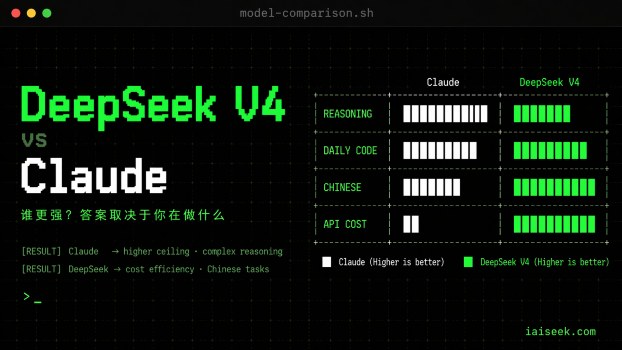
The Core Verdict
Claude is more reliable on complex reasoning, long-document recall, multi-step planning, and code refactoring. It's one of the highest-ceiling models available right now. DeepSeek V4 uses MoE architecture (1.6T total parameters, 49B active) to deliver genuine frontier-level performance at open-source, fraction-of-the-cost pricing — with strong advantages in Chinese-language tasks and bulk workloads.
One-line version: Claude wins on overall ceiling. DeepSeek V4 wins on value per dollar.
If You're a Developer Working on Complex Engineering
Choose Claude.
On multi-file reasoning, large codebase refactoring, and complex bug tracing, Claude Opus holds a consistent lead. It understands code intent more deeply, produces tighter outputs, and stays on track in long-chain tasks where one wrong step compounds. If your work involves the kind of complexity where touching one thing breaks three others, Claude's reliability advantage is real and measurable.
DeepSeek V4 is highly competitive on everyday coding and repository comprehension — especially on projects with Chinese annotations and comments. But on the hardest tail-end tasks, the kind that require tracking logic across multiple abstraction layers simultaneously, it doesn't match Claude's consistency.
If You Run High-Volume Tasks or Have Budget Constraints
Choose DeepSeek V4.
API pricing is roughly 1/10 to 1/30 of Claude depending on the tier. If you're making thousands of calls a day, processing large batches of documents, or running bulk code reviews, that cost gap determines whether a project is viable at all. At this price point, DeepSeek V4 has no real competitor. It's fully open-source, supports local deployment, and further reduces marginal cost at scale.
Claude has no pricing advantage here. If budget is a hard constraint, the decision doesn't require much deliberation.
If You Work with Very Long Documents or Need Precise Recall
Choose Claude.
Claude's recall quality degrades less over ultra-long contexts. It's not just about fitting content into the window — it's about reliably surfacing specific details from 100K+ token documents without dropping critical information. For legal document review, academic research, or large codebase analysis where missing one detail matters, Claude's precision holds up better.
DeepSeek V4 ships with 1M context as standard, which covers most real-world scenarios. But at the extreme end of long-document precision recall, Claude is more consistent.
If Your Work Is Primarily in Chinese
Choose DeepSeek V4.
Chinese-language capability is a structural advantage for DeepSeek V4, not a marginal one. On Chinese technical documentation, code with Chinese annotations, and Chinese content generation, it consistently matches or outperforms Claude. This applies to both comprehension and output quality.
Claude handles Chinese well enough, but in purely Chinese-language workflows it's not the optimal choice.
Side-by-Side Comparison
| Dimension | DeepSeek V4 | Claude |
|---|---|---|
| Complex reasoning / multi-step planning | ★★★★☆ | ★★★★★ |
| Complex code refactoring | ★★★★☆ | ★★★★★ |
| Everyday coding / repo comprehension | ★★★★★ | ★★★★☆ |
| Ultra-long context recall | ★★★★☆ | ★★★★★ |
| Chinese-language tasks | ★★★★★ | ★★★★☆ |
| API cost | Very low | High |
| Open source / local deployment | ✅ | ❌ |
| Output consistency on hard tasks | ★★★★☆ | ★★★★★ |
The Most Common Misreads
"Claude is stronger" doesn't mean "Claude is right for you."
Most comparative coverage ranks Claude's ceiling higher — and that's accurate. But most people's actual workloads never reach that level of difficulty. If 80% of your work is routine coding, document processing, or Chinese-language content, DeepSeek V4 already operates at the top tier for those tasks. Paying more for Claude won't produce proportional gains.
The other common misread: treating "open source" as a signal of compromise. DeepSeek V4's open-source release is a genuine frontier model, not a capability-reduced alternative. The lower price comes from architectural efficiency, not from cutting corners.
FAQ
Q: Can DeepSeek V4 replace Claude entirely? For most users' everyday tasks, yes. On the hardest reasoning and multi-step agent scenarios, Claude still has a real edge that DeepSeek V4 doesn't yet close. Full replacement depends on what you're actually doing day to day.
Q: Is it worth subscribing to both? For heavy users, yes. Using DeepSeek V4 as the default for daily and bulk tasks, and routing the hardest jobs to Claude, is currently the highest-value combination. You're not paying Claude prices for everything, but you still have access to its ceiling when you need it.
Q: Which Claude version are we comparing here? This comparison is Claude Opus (flagship tier) against DeepSeek V4 Pro. Claude Sonnet sits closer to DeepSeek V4 on cost, but with a corresponding capability step-down. If cost is the main consideration, Sonnet vs DeepSeek V4 is the more relevant comparison.
Q: DeepSeek is a Chinese company — does that affect the decision? For local deployment or self-hosted setups, your data stays entirely within your own infrastructure. For API or chat.deepseek.com usage, the considerations are the same as any cloud AI service — assess based on your data sensitivity and compliance requirements.
Final Verdict
Choose Claude if you need the most reliable flagship — complex reasoning, multi-step planning, precision long-document recall, high-stakes refactoring. Its ceiling is higher and its consistency on hard tasks is better.
Choose DeepSeek V4 if you need strong performance at a fraction of the cost — everyday coding, Chinese-language work, bulk processing, open-source deployment. At this price point, nothing competes with it.
The two aren't mutually exclusive. For serious users, running both and routing by task type is the current optimal setup.