


Bottom line: GPT-5.5 has stronger raw intelligence. DeepSeek V4 delivers better overall value. The gap between them is smaller than most people expect.
Both models landed in April 2026 within a day of each other — GPT-5.5 by one day, DeepSeek V4 preview open-sourced the same afternoon. The timing wasn't a coincidence. This is a direct matchup.
The Core Difference
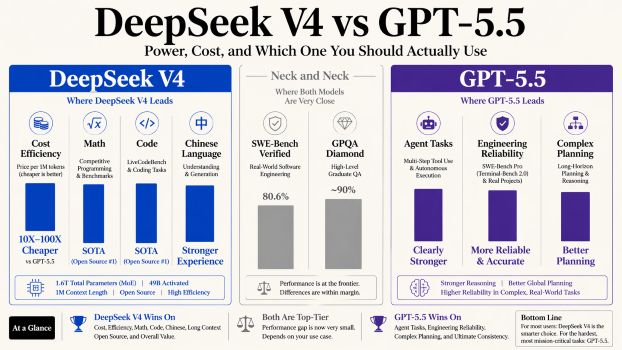
GPT-5.5 is the current benchmark leader in closed-source frontier AI, particularly in agent tasks and real-world engineering. DeepSeek V4 uses a MoE architecture (1.6T total parameters, only 49B active) to deliver top-tier reasoning at open-source, fraction-of-the-cost pricing — with 1M context as standard.
One-line version: GPT-5.5 chases the absolute ceiling. DeepSeek V4 chases the best ceiling-per-dollar.
Benchmark Comparison
| Benchmark | DeepSeek V4 (Max Thinking) | GPT-5.5 | Winner |
|---|---|---|---|
| Terminal-Bench 2.0 (agent coding) | 67.9% | 82.7% | GPT-5.5 by a clear margin |
| SWE-Bench Pro (real GitHub issues) | 55.4% | 58.6% | GPT-5.5 slightly |
| SWE-Bench Verified | 80.6% | Undisclosed | Roughly even |
| GPQA Diamond (hard reasoning) | 90.1% | Undisclosed | Close |
| LiveCodeBench / math competitions | Multiple open-source SOTAs | Close or slightly behind | DeepSeek advantage |
GPT-5.5 leads by 3–15 points on the hardest agent coding tasks. On pure math and competitive reasoning, DeepSeek V4 has caught up to the same tier.
Head-to-Head Breakdown
Agent tasks and complex planning
GPT-5.5 is more reliable on multi-step tool use, large codebases, and cross-turn error correction. Its plan-execute-debug loop is noticeably better than its predecessor, and it produces tighter outputs with lower token consumption. DeepSeek V4 handles single-pass tasks well, but in high-stakes long-chain agent scenarios where one failure cascades, GPT-5.5 holds the edge.
Code and Chinese-language content
DeepSeek V4 flips the dynamic here. Developers working with Chinese-annotated code or Chinese-language documentation consistently report that it "understands the context better." This is a structural advantage benchmarks don't capture well, and it applies to both code generation and Chinese content writing.
Creative writing and general conversation
GPT-5.5 feels more natural, more globally aware, and better at maintaining coherent intent across long conversations. DeepSeek V4 is strong in open-ended dialogue but can drift in extended multi-turn sessions.
Multimodal
GPT-5.5 has more complete multimodal support. DeepSeek V4 is primarily optimized for text and code.
Speed and cost
DeepSeek V4 wins by a wide margin. API pricing is roughly 1/30 to 1/100 of GPT-5.5 depending on usage tier. It's fully open-source, supports local deployment, and ships with 1M context as a standard feature. At high API call volumes, this cost difference changes the decision entirely.
Summary Table
| Dimension | DeepSeek V4 | GPT-5.5 |
|---|---|---|
| Raw intelligence | ★★★★☆ | ★★★★★ |
| Agent / complex engineering | ★★★★☆ | ★★★★★ |
| Pure coding / math | ★★★★★ | ★★★★☆ |
| Chinese-language tasks | ★★★★★ | ★★★★☆ |
| Context window | 1M (standard) | Undisclosed |
| Open source | ✅ Fully open | ❌ Closed |
| API cost | Very low | High |
| Local deployment | ✅ Supported | ❌ Not available |
How to Choose
Pick GPT-5.5 if you:
- Run agent workflows where reliability is non-negotiable — large codebases, automated multi-step repairs, high-stakes long chains
- Have low tolerance for failure cascades and need the most consistent output
- Are already embedded in the OpenAI ecosystem and switching costs outweigh the difference
Pick DeepSeek V4 if you:
- Work primarily in coding, math, or long-document analysis — it's already top-tier here
- Do most of your work in Chinese, where it has a structural advantage
- Are cost-sensitive, especially at high API call volumes
- Need open-source or local deployment
- Are based in a region where ChatGPT access is inconsistent
Use both if you:
- Are a heavy user who routes tasks by type
- Default to DeepSeek V4 for daily work and switch to GPT-5.5 for the hardest agent jobs
The Most Common Misreads
Misread 1: Benchmark score = real-world experience. GPT-5.5 leads by 15 points on Terminal-Bench. Most people's actual tasks don't hit that level of difficulty, which means the felt difference will be much smaller than the numbers suggest.
Misread 2: Open source = lower quality. DeepSeek V4's open-source release is frontier-grade, not a "free alternative that kind of works." It's a different business model, not a capability compromise.
Misread 3: Low price = some catch. DeepSeek V4's cost advantage comes from architectural efficiency (MoE), not from cutting capability. There's no hidden tradeoff.
FAQ
Q: Can DeepSeek V4 fully replace GPT-5.5? For most developers, yes — across 80%+ of everyday tasks. In the most demanding agent scenarios and situations where output reliability carries high stakes, GPT-5.5 still has a real edge.
Q: What about data privacy with DeepSeek? Self-hosted or local deployment keeps your data entirely in your own infrastructure. Using the API or chat.deepseek.com carries the same considerations as any cloud AI service — assess based on data sensitivity.
Q: How much more expensive is GPT-5.5? API pricing is currently 30–100x higher than DeepSeek V4. At low usage volumes the dollar difference is manageable. At scale, it's a fundamentally different budget decision.
Q: Both models are iterating fast — does this comparison still hold? Yes, for now. But the gap will keep narrowing. DeepSeek's iteration pace suggests its next version could close the agent capability gap meaningfully. What's true today may look different in three months.
Final Verdict
GPT-5.5 is the current peak for raw intelligence and the safest bet for the hardest agent tasks. DeepSeek V4 has brought frontier-level performance to open-source, low-cost, long-context territory — and for the majority of real-world use cases, it's already the better overall choice.
The real question isn't "which is stronger." It's whether your specific workload actually needs the extra margin GPT-5.5 offers, or whether DeepSeek V4's combination of capability, cost, and openness already covers everything you need.