


The short answer: it depends on what you actually do every day — not which model scores highest on benchmarks.
Chatting, tracking news, writing code, generating images. These are four completely different jobs. Conflating them is how people end up paying for subscriptions they barely use.
Here's how to think about it by task.
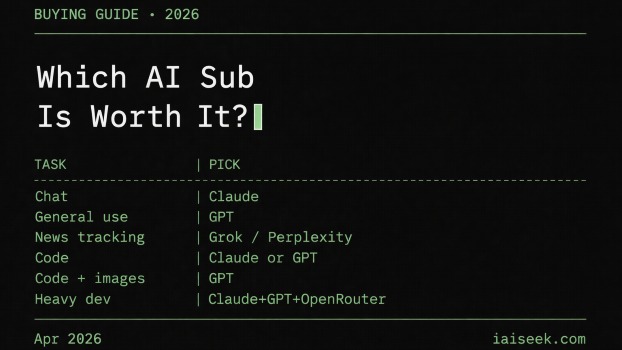
Most People Ask the Wrong Question
"Who's the smartest?" "Which one ranks #1?" "Which model has the biggest context window?"
None of that helps you pick a subscription.
The question that actually matters: what do I use AI for most, on a regular workday?
Because the gap between "most capable" and "most useful for you" is often wider than people expect.
If You Mostly Just Chat With AI
Get Claude.
By "chat" I mean the everyday knowledge work: explaining concepts, organizing thoughts, rewriting a paragraph, thinking through a decision, turning a vague idea into something concrete.
Claude's edge here isn't raw intelligence — it's conversational rhythm. Responses feel complete rather than clipped. Long documents get summarized without losing nuance. Multi-turn conversations don't derail. The output usually needs less cleanup.
Ranking for pure chat: Claude > GPT > Gemini > Grok
GPT leans more toward task-completion mode, which can feel slightly mechanical in pure conversation. Gemini and Grok aren't unusable, but neither creates a strong "I need this specifically" pull for chatting alone.
If You're Subscribing Mainly to Follow Current News
Switch your mental model entirely. Chat quality and real-time information retrieval are different skills.
Tracking breaking news requires: fresh data, clear sourcing, fast cross-referencing. That's a product infrastructure question, not a language model quality question.
From that angle, Grok and Perplexity sit closer to the "real-time information feed" end of the spectrum than Claude or GPT do.
Claude and GPT are better at the second pass — understanding, synthesizing, and writing about information you've already gathered. They're not the strongest first-stop for live news retrieval.
If news tracking is your primary use case, the ranking logic changes completely. Don't apply the chat model hierarchy here.
If You're a Developer Writing Code,Claude or GPT. Pick one, or run both.
What developers actually need isn't a model that can generate boilerplate. It's a model that can hold context across a large codebase, explain a confusing error in plain terms, work through multi-round debugging without losing the thread, and rewrite a function without breaking the ones around it.
Both Claude and GPT handle this well. The difference is style, not capability ceiling:
- Claude tends to be stronger at reading long files, explaining complex logic, and producing complete refactors. Better when you need it to fully think through a solution before outputting anything.
- GPT is more fluid across mixed workflows — code plus documentation, code plus image generation, code plus whatever else lands in your day. Lower switching cost if your work isn't purely technical.
If your day is mostly code: start with Claude. If your day is code plus a lot of other things: GPT handles the context-switching better.
If You Need Both Code and Image Generation
GPT.
Once you need code and images in the same workflow, this stops being a single-task comparison. You need a product that can move between them without friction.
GPT's advantage here isn't that it's the best at either task individually. It's that the full chain — idea, draft, code, image, revision — can happen inside one product. That continuity has real value. Jumping between tools for every step is where time actually gets lost.
If You're a Heavy Developer
Claude + GPT + OpenRouter.
One subscription stops being enough once you hit the real constraints: platform rate limits, wanting to test multiple models on the same problem, needing API flexibility, managing cost at scale.
- Claude keeps its independent value for long-context code comprehension and detailed technical explanations
- GPT becomes the general hub — everything that isn't pure code still gets routed there
- OpenRouter isn't a replacement for either. It's the orchestration layer: model flexibility, cost control, workflow automation without being locked to one provider's interface
Serious developers eventually stop looking for one perfect model and start building a stack. This combination is the most common version of that stack right now.
Decision Table
| Your main use case | Recommended |
|---|---|
| Everyday chat and writing | Claude |
| One general-purpose tool | GPT |
| Real-time news and research | Grok or Perplexity |
| Writing code | Claude or GPT |
| Code + image generation | GPT |
| Heavy development work | Claude + GPT + OpenRouter |
Who Gets This Wrong Most Often
People who confuse a model's capability ceiling with what they'll actually use.
Buying the heaviest coding plan when you mostly chat. Running three subscriptions simultaneously and using none of them seriously. Paying for image generation that hasn't been touched in two months.
The most common AI subscription mistake isn't picking the wrong product — it's overestimating how deep your usage will actually go.
Unless you're already hitting limits on a free or lower tier, don't upgrade. Let your actual usage tell you when you've outgrown something.
FAQ
Q: I'm not sure which category I fall into. Where do I start?
Use a free tier for a month and track what you keep coming back to. The task you repeat most often is the one that should drive your subscription decision.
Q: If I have to pick one between Claude and GPT, which is it?
Does your work involve writing code regularly? If yes, either works — test both. If no, Claude's conversational quality tends to feel like better value for pure knowledge work. GPT makes more sense if you have a wide mix of tasks and don't want to think about which tool to open.
Q: Is Gemini worth considering at all?
In isolation, it's hard to make a strong case over Claude or GPT for most use cases. The exception: if you're heavily embedded in Google Workspace — Gmail, Docs, Drive, Calendar — Gemini's integration changes the value calculation significantly.
Q: Is Perplexity worth a standalone subscription?
If real-time research and news tracking are core to your workflow, yes. If your main needs are writing and coding, it's lower priority.
Q: What about running Claude and GPT at the same time — is that overkill?
For most people, yes. For developers who are already hitting output limits or regularly want to compare model responses on the same problem, it starts to make sense. The signal that you need both is when you're actively frustrated by one of them on a specific task type, not just curious about the other.
Final Call
The AI subscription market in 2026 has split into distinct lanes — chat, code, real-time information, image generation. Each lane has a different best answer.
The subscription worth paying for is the one that reliably saves you time on the thing you actually do, not the one that looks most impressive in a feature comparison.
Figure out your primary task first. The right subscription becomes obvious from there.