


Jan 14, 2026 · 24-Hour AI Briefing: Meta Bets Big on AI Glasses Scale, Google’s UCP Targets “Agent Checkout,” and Dell Pushes PowerStore to 2PB with 30TB QLC
Today’s updates map to three “infrastructure” fronts: the next mass-market AI device form factor (smart glasses), the next commerce protocol layer (agent-native checkout), and the next enterprise data substrate (high-density all-flash). The shared signal: AI is moving from software capability into scale production, standards, and cost curves.
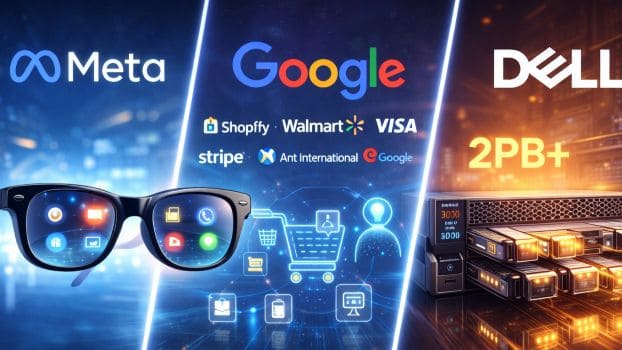
1. Meta and EssilorLuxottica discuss doubling AI smart glasses output by end of 2026, targeting 20M units (potentially 30M)
Commentary:
Smart glasses may become one of the first AI-native device categories to scale beyond phones. In wearables, glasses have structural advantages: always-on, first-person, hands-free. If voice assistance, capture, real-time translation, and ambient info become truly frictionless, the category can cross from “geek toy” to daily consumer product.
Meta’s AI narrative isn’t universally loved, but its glasses product has shown real demand. With a path toward ~10M annual capacity by 2026 already in sight, reports of “supply constrained” demand since the Ray-Ban Meta Display launch in late 2025—strong enough to slow international expansion to prioritize US availability—help explain the push to accelerate capacity.
This is not just “making more units.” It’s a platform bet: that AI glasses can become the next mainstream compute surface after smartphones, assuming ecosystem, privacy norms, and use-cases mature in parallel.
2. Google and partners (Shopify, Walmart, Target, Visa, Stripe, Ant International) launch the Universal Commerce Protocol (UCP)
Commentary:
UCP’s core ambition is to make “agents can place orders” a portable capability. If it becomes a de facto commercial language, it functions like a cross-platform “commerce API layer” that standardizes the fragmented transaction flow into something automatable.
Historically, Google’s commerce value sat in referral traffic. In an AI-native world, users may stop clicking links, weakening classic search ads. UCP is strategically about upgrading Google from “shopping discovery” to “transaction surface,” shifting value from clicks to the conversion path inside Search/Gemini.
If standards stick, the winners will be whoever controls implementation depth, default integrations, and the payments/risk stack. The open question is user comfort: would consumers want an agent to handle discovery → comparison → checkout end-to-end?
3. Dell adds 30TB QLC drives to PowerStore, pushing effective capacity to 2PB per appliance
Commentary:
Dell’s move is about pushing all-flash further down the cost curve, pulling more capacity-heavy workloads off hybrid arrays and even spinning disks. That can materially change enterprise storage buying logic.
QLC has historically been framed as “cold/archival” due to endurance and performance concerns, but Dell is leaning on PowerStore’s software-defined architecture: mixing QLC (e.g., 5200Q) and TLC (e.g., 5200T) in the same cluster with intelligent tiering by workload temperature.
For enterprises building AI infrastructure, private cloud, or data lakes, the pitch is straightforward: lower cost per TB without giving up the all-flash operational experience, making flash a default rather than a premium tier.
Closing:
Meta is betting on the next device front door, Google is positioning for the next commerce protocol layer, and Dell is reshaping enterprise data cost curves. If you had to pick one that builds a scalable moat first in 2025, which is it: AI glasses, agent-native commerce standards, or high-density all-flash?
Further reading (top AI events in the last 72 hours):